











































































E-Invoicing
7 Powerful Reasons Why E-Invoicing in the UAE
7 Powerful Reasons Why E-Invoicing in the UAE Is Transforming Businesses
Table of Contents
- 1 7 Powerful Reasons Why E-Invoicing in the UAE Is Transforming Businesses
- 1.1 1. E-Invoicing in the UAE: What It Really Means
- 1.2 2. Why Is the UAE Introducing E-Invoicing? (And Why It’s Good for You)
- 1.3 3. The Real Advantages You Gain with E-Invoicing in the UAE
- 1.4 4. How Does E-Invoicing in the UAE Work? A Simple Narrative
- 1.5 5. The New Role of Compliance in UAE E-Invoicing
- 1.6 6. The Road to PEPPOL and Global Digital Trade
- 1.7 7. The Big Question: “How Do We Start?”
- 2 A Positive, Actionable Recommendation for You
- 3 Final Thoughts
As an E-Invoicing expert in the UAE working with clients across the US, UK, and GCC, I have seen firsthand how E-Invoicing in the UAE is reshaping the way businesses manage finance, compliance, and operations. And let me assure you—this is not just a government mandate. It’s a once-in-a-decade opportunity for companies to future-proof how they work.
Yet, many organizations today—especially SMEs—still feel confused, overwhelmed, or even intimidated by the idea of adopting a fully digital invoicing system.
If you’re reading this, you may be asking yourself:
- “Do I really need E-Invoicing?”
- “Is it complicated?”
- “Will I need new software?”
- “What if we make mistakes—will there be penalties?”
- “Is this another expensive compliance project?”
These questions are valid. And they’re exactly why this guide exists.
Let’s take a clear, simple, and human approach to understanding how E-Invoicing in the UAE works—and why it’s not only doable, but deeply beneficial to your business.
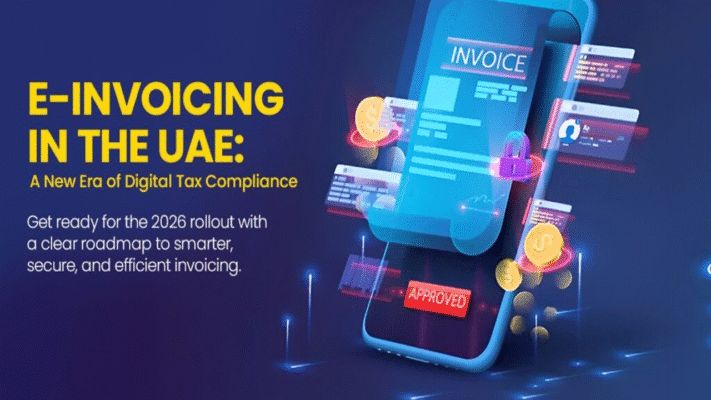
1. E-Invoicing in the UAE: What It Really Means
To put it simply, E-Invoicing in the UAE is the digital creation, exchange, and storage of invoices in a structured, standardized format recognized by the Federal Tax Authority (FTA).
It is NOT:
- scanning a PDF
- sending invoices via WhatsApp
- emailing a photo of a receipt
- using Excel sheets that can be edited anytime
E-Invoicing is about structured data—real invoices generated in a digital language that systems can read, validate, and share in real time.
The UAE is moving toward a global-standard e-invoicing model, aligned with PEPPOL and widely accepted international tax digitalization frameworks.
This ensures transparency, accuracy, and faster business transactions across all industries.
2. Why Is the UAE Introducing E-Invoicing? (And Why It’s Good for You)
Many business owners think E-Invoicing is “just another compliance update.”
But the truth is, E-Invoicing is being introduced because:
- Fraud needs to be reduced
- Tax compliance needs to be strengthened
- Businesses need protection
- Manual errors need to disappear
- The UAE is preparing for global trade standardization
- Digital transformation is now mandatory for competitiveness
The UAE wants its businesses to operate with global efficiency, not outdated manual processes.
Companies that adopt E-Invoicing today will run faster, smarter, and more securely than those who wait until the last minute.
3. The Real Advantages You Gain with E-Invoicing in the UAE
Let’s break down how E-Invoicing in the UAE directly improves your business.
a. Zero Manual Errors
- No more typos, mismatched amounts, or missing invoice details. Every invoice follows FTA-required fields automatically.
b. Faster Payments
- Digital invoices are delivered instantly and processed faster by customers and systems.
c. Seamless Audits
- Audits become stress-free because the FTA receives real-time, validated invoice data.
d. Reduced Fraud
- E-Invoicing drastically cuts fake invoices, duplicate entries, and tampering.
e. Real-Time Reporting
- Your finance team gets daily, hourly, or even minute-by-minute visibility.
f. Improved Cash Flow
- When invoicing is fast and accurate, payments follow the same pattern.
g. Fully Paperless Operations
- No printing. No filing cabinets. No lost documents. Just peace of mind.
4. How Does E-Invoicing in the UAE Work? A Simple Narrative
Imagine you issue an invoice to a client.
Here’s what happens under the new UAE e-invoicing system:
Your invoicing system creates a structured digital invoice (usually XML/UBL format).
The system validates whether all mandatory FTA fields are included.
The invoice is digitally signed to ensure authenticity.
A unique invoice number is generated for traceability.
The invoice is transmitted securely to the recipient.
The invoice is stored electronically in a compliant format.
Throughout this journey, the FTA can validate data in real time.
This means fewer disputes, faster resolutions, and a cleaner compliance record.
5. The New Role of Compliance in UAE E-Invoicing
A major misconception among business owners is:
“E-Invoicing is just an IT project.”
It’s not.
E-Invoicing is a finance + compliance transformation, supported by IT.
This requires collaboration among:
- Finance
- Tax teams
- Procurement
- Sales
- ERP / accounting system providers
- Your VAT consultant
- Your E-Invoicing solution provider
The companies that treat E-Invoicing as a strategic initiative—not just a rule—gain the most benefits.
6. The Road to PEPPOL and Global Digital Trade
The UAE is moving in the same direction as:
Saudi Arabia
Europe
Singapore
Australia
New Zealand
Many GCC countries
This alignment with PEPPOL networks means companies operating internationally will eventually enjoy one global invoicing standard.
- It reduces friction.
- It reduces cost.
- It enables global business expansion.
And UAE businesses will be at the forefront.
7. The Big Question: “How Do We Start?”
This is where most businesses get stuck.
The journey to E-Invoicing in the UAE usually involves:
Step 1: Assess your current invoicing workflow
- Manual? Semi-automated? ERP-driven?
Step 2: Identify gaps vs. FTA requirements
- Do you support structured invoicing formats?
Step 3: Choose the right E-Invoicing partner
- One that understands UAE regulations, digital signatures, and system integration.
Step 4: Implement and test
- Connect your ERP or accounting system.
- Run invoice validation tests.
- Ensure everything aligns with FTA requirements.
Step 5: Train your teams
- Finance and operations teams must understand the new workflow.
Step 6: Go live
- Your system is ready to transmit and receive validated e-invoices.
A Positive, Actionable Recommendation for You
If your business wants to avoid last-minute compliance pressure, unnecessary penalties, or costly rework, start preparing for E-Invoicing in the UAE now.
Here is what I strongly recommend:
✔ Begin with an E-Invoicing Readiness Assessment
Understand your current systems and compliance gaps.
✔ Choose a solution designed specifically for the UAE regulatory environment
Generic global software may not fully comply with FTA requirements.
✔ Prepare your teams early
A smooth transition relies on awareness, training, and workflow clarity.
✔ Think beyond compliance
E-Invoicing is a catalyst for digital transformation—not a burden.
✔ Leverage automation wherever possible
It reduces human error, accelerates cash flow, and makes invoice management easier.
Final Thoughts
The shift to E-Invoicing in the UAE is not just a regulatory update—it’s a strategic leap toward smarter, more efficient, and more transparent business operations.
Companies that embrace this change early will enjoy:
seamless compliance
faster payments
stronger financial health
improved visibility
and a future-proof digital ecosystem
As someone who has guided hundreds of businesses across the UAE, I can confidently say this:
You won’t just survive the transition to E-Invoicing—you’ll thrive because of it.
If you need help understanding the system, preparing for compliance, or selecting the right technology, I’m here to guide you every step of the way.
#EInvoicingUAE #DigitalTransformationUAE #UAEBusiness #TaxCompliance #EInvoice #FTAUAE #DigitalFinance #PaperlessUAE
Thanks for reading! Stay curious, keep exploring.